Wine Bar at Soup ‘n Bagles

Cheryl Marie Cordeiro, Svante Boberg who is owner of Sou''n Bagel and Sandra Lam Carlsson.

An evening of open wine testing at Soup’n Bagel. In the middle, owner Svante Boberg and to the right friend and colleague Sandra Lam Carlsson.
Text and Photo © JE Nilsson and CM Cordeiro 2012

In from the biting cold of winter that is still in the air in Sweden, I thought the cozy, dimlit interior of Soup’n Bagel by night in the city of Gothenburg set the perfect calm and mellow atmosphere for an evening of wine tasting and long conversation amongst good friends.

Some wines for the evening with Connoisseur Depot and Soup'n Bagel.

Some wines for the evening with Connoisseur Depot and Soup'n Bagel.

Magnus Lilja and Sandro Schöpper of Connoisseur Depot hosted the evening and presented guests with some wines they found to stand out from the sea of well made but sometimes indifferent reds and whites, that are the majority of wines that one meets today regardless of origin. Whatever you think and hope for, it usually takes an adventurous testing together with some relevant food samples for anyone to get to know what lurks under the label.

And given enough number of times by which you make a point to try a wine from a different country, region or even method of make, you’ll soon find yourself well on your way to making some really good acquaintances.

Tapas styled dish, at Soup'n Bagel.

Brie to Reisling.

The wine-by-the-glass concept, with a touch of tapas bar, exactly as how our long time friends Magnus and Sandro hosted tonight is indeed a splendid way of getting acquainted with what some experienced experts in the field have found interesting lately.

Both of them took time to explain the finer details of each wine presented and of course could not resist the possibility to tote their own very favourites of the lot, or rather ‘loot’ would be the more appropriate description of the selection presented.

Magnus Lilja and Sandro Schöpper of Connoisseur Depot.

Magnus (left behind the counter) and Sandro (right behind the counter) of Connoisseur Depot, introduce guests to interesting wines for the evening.

After a long week at the office cubicle for some, many guests admittedly loved the whole idea of this evening’s wine tasting and sampling that allowed, even encouraged trying some different wines that run tangent from our regular choices.

It was only towards the close of the evening that most of us found our way back to our special favourites with a feeling of satisfaction, a mission accomplished.

It was a quiet evening of soft talk, laughter and calm. A much needed Friday night, just the right thing to do to unwind to the start of a weekend.

Thank you Magnus, Sandro and Svante for the Wine Bar Invite! It was a pleasant evening indeed.

HBR and pie

Cheryl Marie Cordeiro 14012012

The best breakfasts come from not planning any at all.
Text and Photo © JE Nilsson and CM Cordeiro 2012

It’s been just about three weeks since the winter solstice here in the northern hemisphere. Where I sit along the Swedish west coast, the days get longer by about two minutes each passing day, the sun still rising at about 08:45 hrs in the morning and setting still before 16:00 hrs, at least for another week or so.

06:00 hrs on a Saturday morning, with a click of a mouse, I pull up daily news from CNN, the BBC, the New York Times, Svenska Dagsbladet, Corriere della Sera, China Daily etc. and find myself browsing information on the continuing Euro crisis, the civil unrest in Syria, the cruise ship Costa Concordia running aground in Italy, Taiwan’s exciting but tense upcoming elections as Beijing watches hawk-eye etc. Through all those bits of news I realize how it is sometimes difficult to fathom the very idea of happiness.

Ketamined from the news, you sit back, take a deep breathe and find yourself confronted with what seems like life’s utmost fundamental existential questions – Who am I? What am I? Why am I here? and What’s for breakfast?
Continue reading ‘HBR and pie’

Dulce de Leche thoughts in the stillness of the first week of 2012

490 Dulce de Leche 048

A dulche de leche breakfast with homemade rye bread.
Text and Photo © JE Nilsson and CM Cordeiro 2012

The first day of the New Year is usually known as ’Pizza Day’ in Sweden, only because people here have partied too much, too fast, too hard the previous night that ordering pizza to the home, or simply settling down in a restaurant for one seems to put into command everything else that is not, for the moment. It’s worry free.

Connected to being worry free that to me is like the experience of having caramelized condensed milk on bread at breakfast as a Madeleine moment these days, is also the experiencing of the calm at work this first week in 2012.

At this time of year in Sweden, most people are still on holiday leave and it is perhaps the last few days of the festive season where you can continue experiencing the stillness and tranquil of the short days, grey blanket in the evening skies, before speed sets in again at the office that continues till just before the summer season.

But for the Swedish Handelsbanken, the first week of the year isn’t quite as still as all might have hoped due to a slight glitch in PR or due to the efforts of one over-zealous employee, who had circulated via the internet, the company’s in-house Christmas Letter, resulting to it being picked up by the Swedish newspapers.

In the world of corporate talent management that is my daily reality, there is nothing more cogent than aligning corporate strategy with human capital and talent development (MIT Sloan Management Review), which was what I thought the President and CEO of Handelsbanken, Pär Boman did well in his Christmas Letter to the employees of the organization.

Reading through the letter where amidst the numbers, the usual organization motivation talk and jargon, what hit home with me were the words of the very last paragraph, where against the so well-known consensus seeking, lateral and decentralized management style found in Swedish organizations, came Boman’s call for the “traditional, central directive” to employees, to “…withdraw from all the stress and work, light a candle, look out of the window at the snow and enjoy an extra good cup of coffee and some Christmas cakes…. [because] we’re well worth it…”

Dulce de Leche indeed.

A magical evening with Ulf Wagner at Sjömagasinet, in Gothenburg 2011

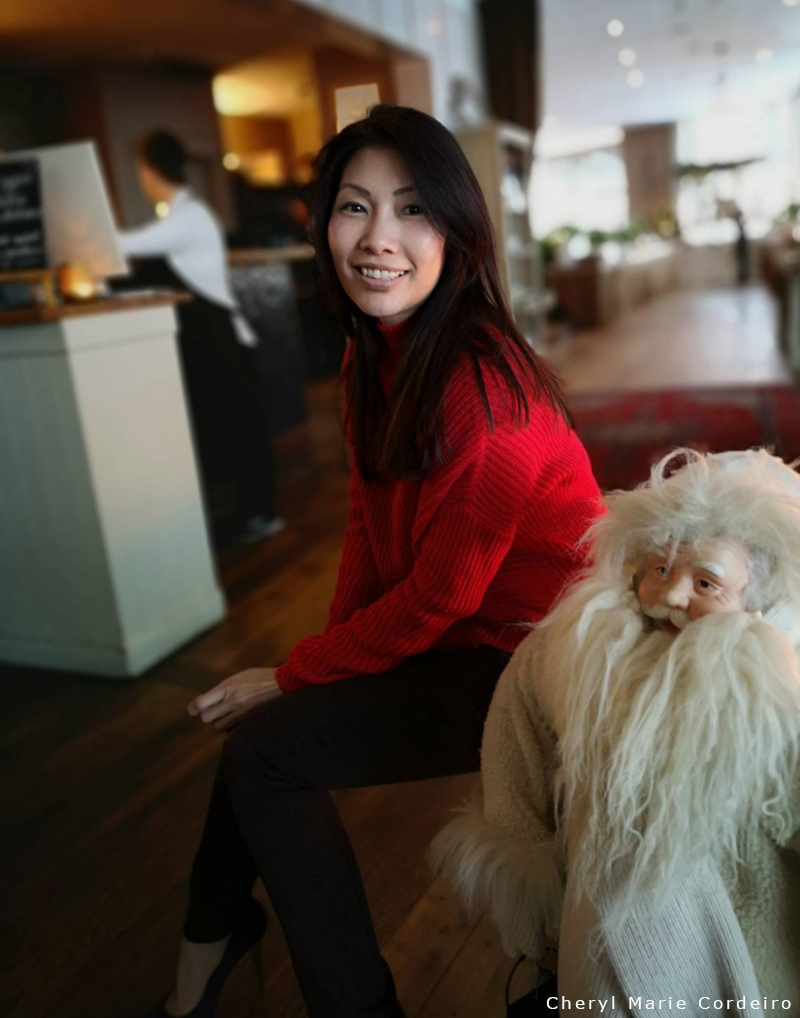
Cheryl Marie Cordeiro with house elves at jultide, Sjömagasinet 2011

Restaurant decoration at Sjömagasinet. In Swedish folklore well managed farm houses was looked after by their own house elf or elves. They were quiet and mostly invisible but kept themselves informed from the animals if everything was done right and proper. The house cat was their eyes and ears during daytime. If the people were good, the elves would help take care of the house and the family that lived there. Eventually these elves merged in Swedish lore with the later idea of a Juletide Tomte that brings the Christmas gifts.
Text and Photo © CM Cordeiro, JE Nilsson and T Eliasson, 2011

In the past years, we’ve dined enough at Sjömagasinet in Gothenburg (2009a, 2009b, 2008, 2007) to feel quite at home at what was once the old outfitting warehouse for the Swedish East India Company (1731-1813). In the 18th century their ships made round trips from Gothenburg to China and back where each trade voyage took about two years, bringing back immense fortunes for the participants.

During their many voyages these ships would dock at various ports around the world including Cadiz in Spain, to pick up silver and Batavia in Indonesia for spices, before reaching Canton in China. Besides tea, silk and spices they contributed significantly to the cultural exchange of knowledge between Sweden and Asia and brought back many important influences, not the least within the medical and culinary field that is so intriguingly interconnected. In this wharf equipment were stored such as sails, masts, spars and all things you might imagine being needed on a wooden ship about 50 meters long. The spirit of these adventures is still felt in the very walls of this building.
Continue reading ‘A magical evening with Ulf Wagner at Sjömagasinet, in Gothenburg 2011′

Christmas postcard from Sweden, 2012!

Christmas Greeting Cheryl Marie Cordeiro 2012 032

Photo © CM Cordeiro and JE Nilsson 2011

Christmas Eve morning at Saluhallen in Gothenburg at 09:01 hrs

Going to the market, is just … going to the market, isn’t it? So mundane a task that it’s hardly a concept to be discussed by most. But come Christmas in Sweden, and come the darkest days of the year, the Swedish Christmas markets that glow a warm orange and red whether they be outdoors or indoors become central gathering nodes for the people of the city.

Christmas Eve morning at Saluhallen 2011, chairs.

And all was apparently still on Christmas Eve morning as the doors to the marketing heart of Gothenburg that is Saluhallen was opened.
Text and Photo © CM Cordeiro and JE Nilsson 2011

Cheryl Marie Cordeiro, in the morning at Saluhallen in Gothenburg, Christmas market 2011

The early morning calm didn’t quite stop me gushing in haste when my eye caught a table decoration I so wanted at home at our Christmas table!

Everyone has a Christmas foodlist for their own Julbord to tend to, making Christmas Eve marketing all the more festive. And amidst waiting in queue for your number to be served, you can hear the hearty exchange of Christmas recipes amongst those waiting in line for baked ham, pickled herring and roasted spare ribs that gives a heartwarming preview of what others are about to have this evening at home.

In my number of years in Sweden, I’ve visited these Christmas markets year after year, with Saluhallen and Haga in 2010; 2009a, 2009b; Kronhuset in 2009; a compilation of Saluhallen and Haga in 2008; Haga in 2007, to which I’ve always found something new in my explorations and visits.

This year’s visit is a slight variation, an authentic visit to a market on Christmas Eve for some Christmas marketing, instead of visiting a ‘Christmas Market’.

Continue reading ‘Christmas Eve morning at Saluhallen in Gothenburg at 09:01 hrs’

Jultide traditions at the GU School of Executive Education, University of Gothenburg

GUSEE Julbord 2011 - Sandra Lam-Carlsson, Cheryl Marie Cordeiro and Jenny Yu.

At the GU School of Executive Education’s Julbord 2011, Sweden.
L-R: Sandra Lam-Carlsson, Cheryl Marie Cordeiro and Jenny Yu.

Text and Photo © PO Larsson, CM Cordeiro, JE Nilsson 2011

In line with the underlying ideals and innovative thoughts in the culinary field from this year’s Prins Bertil Seminar 2011 at the School of Business, Economics and Law at the University of Gothenburg, that raised the level of consciousness about food in general, from farm to restaurant table and how the best dishes can be had from simply using the freshest ingredients and not necessarily the most fancy and exclusive of raw produce, it was the initiative of Dr. Per-Olof Larsson (CEO of the GU School of Executive Education), followed by a very Swedish consensus style organization meeting that we tried our hand at a traditional homemade Julbord or Swedish Christmas smörgåsbord this year, to put a touch of rustic heart into our Jultide celebrations.
Continue reading ‘Jultide traditions at the GU School of Executive Education, University of Gothenburg’

Lulling hours in Shanghai, where old meets new…

Cheryl Marie Cordeiro, Yuyuan, Shanghai 2011.

Along the streets at Yuyuan, Shanghai.
Text and Photo © CM Cordeiro 2011

Waking up in China’s largest city that is Shanghai, amongst its more than 24 million inhabitants certainly puts a perspective on how much of an impact you might make during a single day in your life when you finally step out the door and make your way around with your errands.

In just about twenty to thirty years, Shanghai as a city has grown at an amazing speed. The skyscrapers seen today along the Huangpu River, The Bund and Lujiazui were non-existent just a stone’s throw back in time, where it would’ve been difficult for most anyone to recognize the landscape and skyline of the central finance district between these decades if you were not at first shown pictures of the landscape from then till now.

The past decade alone has seen a paradigm shift in Shanghai from a city with Communist ideals to one that is cosmopolitan with a global outlook. Much of this is the fruitful result of the Chinese government’s efforts at economic reforms in China beginning in the late 1970s and early 1980s.

If any organization could trace and reflect an aspect of Shanghai’s modern history in global trade and the resulting impact of the Chinese government’s efforts at bringing China and its state-owned enterprises to the global scene, then Baosteel Group Corporation, the second largest steel producer in the world with approximate annual revenues of around USD $21.5 billion would be a good case study to examine. With 45 wholly owned subsidiaries in markets across the world, in countries with as diverse cultures such as Brazil, France, Germany, Russia and in Asian and Southeast Asian countries such as Japan, Hong Kong and Singapore , Baosteel reflects the speed and tenacity at which Chinese organizations are able to make themselves visibly global whilst simultaneously catering to their very demanding and highly competitive domestic market.

Still, amongst the city’s global ambitions supported and run by its busy inhabitants who seem to maneuver through the city via just as many noisy and exuberant vehicles that never cease their honking, you’ll find in Shanghai that some waking hours beckon a certain lull to the senses, and are in effect… quieter than others. And it is in these hours that you can sit, think and breathe the calmer soul of the city as a mist that invites you to contemplate its living as an artfully drawn landscape, one perhaps seen in Chinese watercolour on silk or paper. It is these brief lulling hours of Shanghai, at dawn or just after dusk, that paints a picture of the place both past and present, juxtaposed in front of your very eyes in material form.
Continue reading ‘Lulling hours in Shanghai, where old meets new…’

Yuyuan street eating and daily practicalities, Shanghai

Cheryl Marie Cordeiro 7 Dec 2011 Shanghai 03aWith the quick glances of distraction observed from tourists and a slight quickening of their pace past the local lunch scene at Yuyuan in Shanghai, where the local people seemed perfectly at east sitting along the roadside with their bowl of rice in one hand and chopsticks in the other, eating whilst waiting for their next customer to walk into the shop, I understood with clearing clarity that for most of Northern Europe, dining was a much more formal affair around a set table.

And the Northern European concept of dining was quite a contrast to this fairly common aspect of people eating on the move or simply eating outdoors in Asia in general. Whether in India or the various equatorial countries of Southeast-Asia such as Thailand, Vietnam, Singapore and Indonesia, or the more temperate regions of China, food sold along the streets in wheel carted food stalls and eating along the streets is as practical and nomadic as having all your goods for sale stacked onto a single bicycle or motorcycle and sold wherever you found a customer along the street.

Yuyuan wholesaler's street, Shanghai 2011.

Yuyuan Market, Shanghai.
Text and Photo © CM Cordeiro 2011

I grew up in the decades of Singapore where people did cart their goods around and sold them from their bicycles, and where food such as bowls of noodles, plates of fried kway teow and even cold food such as ice-shaved desserts called ice-kachang (a Singapore and Malaysian variation of ‘sorbets’ made from just rough shaven ice and sweetened with colourful syrup dripped all around the cone of ice shavings) were sold from wheel-carted trolleys. For warm dishes, burning charcoal was used for fuel in the mid-1900s for cooking and later on, small portable gas units were used.

Still, the scene in China is much more rustic and unaware – people just didn’t think if you stopped and stared at them eating, because for them, it was all part of the natural process of the day, just another practicality that you have to deal with, seamlessly interwoven into their main activity of the day, which is working. Living and working seamlessly – that is what you’ll witness at lunch hour at Yuyuan.

Continue reading ‘Yuyuan street eating and daily practicalities, Shanghai’

Second Sunday in Advent

coffee

Lussekatter, usually makes its appearance on St. Lucia which is 13 December.
Text and Photo © JE Nilsson & CM Cordeiro 2011

There are definitely some things more than just tradition when it comes to cooking and preparing during the Advent weeks that lead to Christmas. It’s in the air, a solemn feeling of silent expectation.

In all of this, I find it very much soothing to the busy mind, all too often kept spinning by the daily transactions, to relax and just spend the whole day baking.
Continue reading ‘Second Sunday in Advent’