France

The Opéra Garnier in Paris, France

Opera Garnier in Paris, France

The Paris Opera house, also known as Opéra de Paris or Opéra Garnier.
Photo © J E Nilsson for CMC

If there is something that makes the French French, I think that is a certain spirit – they just don’t do boring. It’s in the fashion, women in skyscraper skinny stilettos in the Metro in the morning, their passion for life and, in their architecture. Take this Opera Garnier for example. It’s an orgy in marble and gilt, exudes a love of life and is a grand example of how to do things with panache!

Just consider that they started to plan this building with its surrealistic grandiosity less than half a century after the French Revolution in 1793, when Louis XVI and Marie Antoinette had been publicly beheaded because of their opulent life style.

The realisation that there actually is an indoor lake under the basement make you half and half believe that there probably is a phantom somewhere in there too. All sets the stage in our minds for a great theatre play. You just need to step inside and the grand entrance staircase will within the blink of an eyelid place you in the spotlight, on stage in the theatre of life, cast as the star.

Top of the Opera Garnier or Palais Garnier in Paris, France

On the roof are sculptures of Apollo, Poetry and Music by Aimé Millet and Liberty by Charles Gumery.

The grandeur strikes you already when you set your eyes on it from across Place de l’Opéra. Above the golden frilly edge of the roof are statues of Apollo, ‘Poetry’ and ‘Music’. This is the ideal setting and one can think that Gaston Leroux’s Le Fantôme de l’Opéra (1909) must have basically written itself. This was also the story that was later adapted by Andrew Lloyd Webber to the musical, The Phantom of the Opera in 1986 and became one of Broadway’s longest running musicals of all time. I can’t even write the title without hearing the theme in my mind.

Palais Garnier, Opera Garnier, columns, Paris, France

Bronze busts of Beethoven and Mozart on the front façade of the Opéra Garnier in Paris.

The very aura of the building invites dramatic stories to be told and enacted.

Opera Garnier sculptures, Paris, France

Sculpture of dancers entitled, The Dance by Jean-Baptiste Carpeaux.

Charles Garnier was also the architect of Le Grand Casino in Monte Carlo that opened in 1879.

Le Grand Casino, housed together with the Opéra de Monte-Carlo, is a smaller version of the Paris opera, scaled down to a quarter of the size of the former but still in a league of its own, since it was originally also Prince Charles III’s private theatre.

The Eiffel Tower in Paris by night in early spring

Under the Eiffel Tower, Paris, France

Under the Eiffel Tower at night in early spring in Paris, France.
Photo © Jan-Erik Nilsson for CMC, 2009

Considered by the French as a national embarassment and an architectural eyesore on French landscape when it was first erected in 1889, the Eiffel Tower is now one of the world’s most recognizable construction. Though not the highest lattice tower in the world, it could well be the most replicated structure of our time and you can find versions of it in countries such as China, Russia, Kazakhstan, Bulgaria, Romania, the USA and Denmark.

When it was suggested that I should visit the Eiffel Tower by night, I thought that rather a ludicrous idea – what could you possibly see at the Eiffel Tower at night?

But we were in Paris to do all things crazy and romantic, so why not.

It took less than ten minutes from where we were to get to the Eiffel Tower by taxi. When we got out, instead of pitch black deserted grounds as I had expected, we were greeted by crowds of people in vibrant, cheerful spirits. Tourists and Parisiens were there on excursion and you had local street vendors who sold everything from roses to stuffed plush toys, Eiffel Tower keychains and all sorts of sourvenirs they could wrap up under their generous woollen coats.

To my delight, the base of the Eiffel Tower was alive with activity and more than that, the crowd was basked in the warm orange glow of light emanating from the Eiffel Tower by night. And it was this warm glow of light that we found ourselves embraced in, as we walked to the entrance of the Eiffel Tower.

Cheryl Marie Cordeiro, looking up the belly of the Eiffel Tower, Paris, France

Myself, lying on a bench under the Eiffel Tower, looking straight up in to the belly of the trellised structure.

The visual journey and experience of the Eiffel Tower begins even before you get close to its ticketing entrance. The intricately latticed structure knocks the wind right out of your lungs just by you standing at the base, looking up. It’s as if you were looking up into the heart and core of this enormous construction of iron. The flickering lights by night made it look like the Eiffel Tower lived and breathed the very heartbeat of Paris and you’re at once entranced and puzzled by how soft and romantic a piece of metal structure can look.

Continue reading ‘The Eiffel Tower in Paris by night in early spring’

The mysterious ‘Notre Dame’ Cathedral in Chartres, France

The heart of Chartres, the Notre Dame Chartres Cathedral looms impressively over the town and is visible from miles along the plains of Beauce.

The entire landscape around the city of Chartres about 45 km south of Paris, is mostly flat agrarian countryside. Mile after mile of fertile soil made the foundation of wealth that went into the building of this Cathedral. From a distance, the Cathédrale Notre-Dame de Chartres seems to float among the clouds. This impossibly large structure strikes you as unlikely as a Noah’s arch, just stranded on the mountains of Ararat.

The west facade of the Notre Dame in Chartres, a magnificent piece of mid 12th century high Gothic architecture. Its famous Portail Royal, completed about 1155, is currently under restoration. In this picture, the right (south) tower is the original, older, from about 1150. The higher, left (north) tower was rebuilt in 1513 after a fire.

The medieval charm of Chartres envelopes you as a warm cloak even as you approach the small town. The river Eure that runs through the town provides it with a picturesque backdrop and one is immediately taken in by the timbered architecture of the houses that line the cobbled streets, making them look almost right out of a Brothers Grimm fairytale.

At the heart of this city is the massive and striking Notre Dame Cathedral in its Gothic glory. From afar, the looming structure seems to float on clouds. It is only upon drawing closer that you realize that it sits quite solidly, on a hilltop, previously known as The Mound. Continue reading ‘The mysterious ‘Notre Dame’ Cathedral in Chartres, France’

Visiting the Rothschild vineyards in Bordeaux, 2008

Visiting Baron Philippe de Rothschild’s Vineyards in Bordeaux

The region of Bordeaux was legendary to me. I had heard of it long before I ever thought I would visit it. To me, Bordeaux was superior wines, it’s romantically undulating landscapes that the grapevines so needed to grow, the warm weather and the rustic lifestyle of grape harvesting and wine making.

Even though my knowledge of wines is limited to be able to recognize a good wine when I am served one, I expected to hit every single chateau in sight for some wine tasting, inspect all barrels of wines in different stages of aging and come away with much greater knowledge than before I set foot here.

It was such a disappointment then, that the day we had set out to explore Bordeaux, was a French national holiday weekend and all chateaus were closed!

With a sunken heart, we decided to travel around some and take a look at the vineyards and chateaus anyway, targeting one of our favourites, the Rothschild’s vineyards in the Médoc area just northwest of Bordeaux. Since the history of the Rothschild family, as well as the history of the vineyard and the wines all have approached mythical proportions, we decided this was worth doing even if there would be no one on grounds to meet.

A signpost leading the way to maybe the most famous of all vineyards in Bordeaux. The vineyards and chateaus are generally easy to find, following the signs.

The roads were tiny and winding slightly up and slightly down. They were also bare of any vehicles or crowds due to the holiday.
Continue reading ‘Visiting the Rothschild vineyards in Bordeaux, 2008′

Stirred, not shaken, in Monte Carlo

Visiting Le Grand Casino, Monte Carlo.

The kingdom of Monaco is stunningly famous despite its modest land area. Only 800 meters by 4.8 km (0.5 x 3 miles) it is the second smallest country in the world. The only state even smaller is the Vatican inside Rome. As such, you can walk clean through the country of Monaco almost without noticing that you’ve entered or left it. The country is however, fantastically scenic as it clings to the rocky, sometimes vertical slopes of the coast of the Mediterranean sea. One fifth of the entire city-state of Monaco is reclaimed from the sea and the main feature of this place is a very large harbour where the exceedingly rich who live here have their luxury yachts.

A view of more or less the entire Monaco …

… looking absolutely inviting from this vantage point.

Visiting Monaco lent me three associations to it:

The Royal Family of Monaco
First, the troubled and somewhat tragic saga of the Royal family with Prince Rainier marrying the American actress Grace Kelly. They met in 1955 in nearby Cannes when Grace Kelly was heading the American delegation to the Cannes Film Festival. She agreed to have her photograph taken with the Prince and thereafter she visited the Prince’s gardens and his small zoo. They met again about 6 months later in America and got married already in 1956.
Continue reading ‘Stirred, not shaken, in Monte Carlo’

The Cannes Film Festival beach

As the beach was just 100m across La Croisette from our hotel, it was only a matter of grabbing the towels and go!

When in Cannes, there really isn’t much to do in this city except eat, shop and watch movies, so after a hearty breakfast buffet at the Majestic Barrière, we did what most people along the La Croisette were there to do; we went swimming!

The beach crowd: it was hardly noon, but the beach filled up quickly with people wanting to catch some sun and relaxation.

The stretch of beach next to the Boulevard de la Croisette is not much of a beach at all and one that filled up quickly and steadily as it approached noon. However, what makes this place special is that this beach is located immediately next to the Cannes Film Festival main building – the Palais – so when the great movie stars need a bikini shot in front of the paparazzis, here is where they go. This is also the location for all kinds of publicity stunts during the film festival. It is here that Brigitte Bardot introduced the bikini bathing suit in 1953. It was also here that Sacha Baron Cohen introduced his green maillot during his promotion of his film “Borat” in May 2006.

Sacha Baron Cohen as Borat, promoting his film “Borat” at the beach in Cannes, wearing a green maillot, in May 2006.

A view of the beach, with the Palais des Festivals to the left and the hotel Majestic Barrière in the background.

All along the Côte d’Azur, the trend of topless sunbathing is also in vogue from when Brigitte Bardot and friends introduced the concept in nearby St. Tropez in the late 1960s and changed the way modern women sunbathe here today. Women, regardless of age or size, sunbathed topless beside sun-bronzed men basking in the sun or playing beach volleyball nearby.
Continue reading ‘The Cannes Film Festival beach’

Staying at the Hotel Majestic Barrière, Cannes

The Hotel Majestic Barrière offers a splendid view across the La Croisette towards the Cannes Film Festival’s main building with its roof designed as a spacious helipad. To the left, is the beach where a bikini clad Brigitte Bardot introduced a new beach fashion to a whole world in the early 1950s. In the middle is the private entrance for artists to the festival building, right now leading into the Palais Club discotheque. Further out is the Port de Cannes where many large and comfortable private yachts are anchored.

Cannes – City of dreams.

Once a year the city of Cannes becomes the focal point to all who hold any hope of making it into the fame and fortunes of the international movie industry, as it hosts the most important film festival in the world, the annual Festival de Cannes.

The festival started in the 1940s and today attracts more than 200,000 visitors every year. Stars, filmmakers, fans and star-gazers alike plus more than 4,300 journalists, all gather in a city that would normally only house some 70 thousand inhabitants.

Cannes’ climate and location, that comfortably lets it bask in the sun along the French-Italian Riviera – the rocky coastline where Provence faces the azure blue water of the Mediterranean – has proved irresistible and has also become the European summer destination par preference of the rich and famous as it sits right in-between St Tropes, Nice and the miniature kingdom of Monaco.

On the top floor of the Hotel Majestic Barrière, a few unnumbered suites offer spacious comfort and an undisturbed view over the Cannes Film Festival area and the beach.

Continue reading ‘Staying at the Hotel Majestic Barrière, Cannes’

Stalking Louis Vuitton, Europe


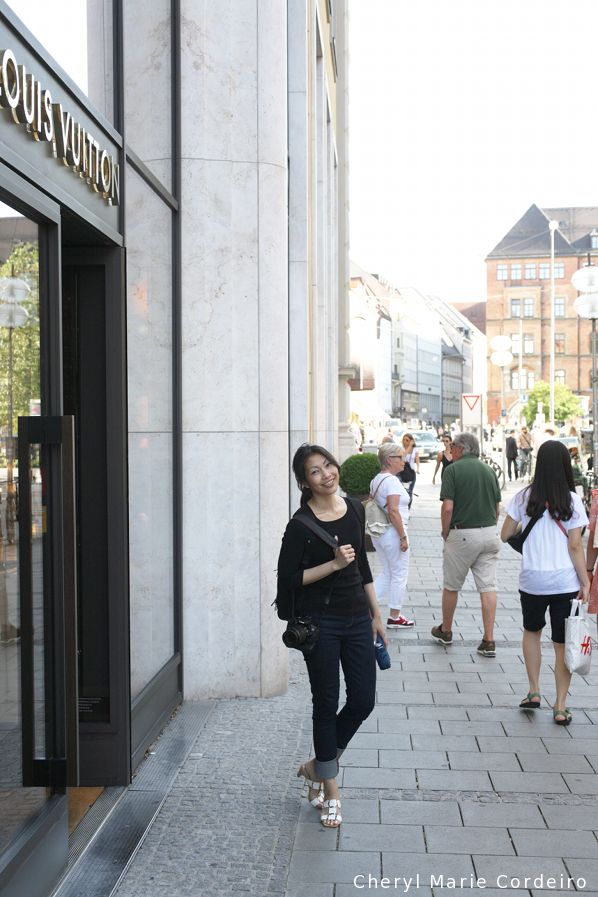
The Louis Vuitton boutique in St. Tropez, Côte d’Azur.

A luxury brand with a history of perseverance and hard work, Louis Vuitton for me is synonymous with ingenious craftsmanship and quality. Unlike my previous travels to Hong Kong and Paris, where I had deliberately stalked Louis Vuitton boutiques, this time around in Europe, it happened that I more often chanced upon a Louis Vuitton boutique whilst walking about town, on the more exclusive streets.

Part of their brand management includes no outlet shopping and opening a boutique only where there are an estimated 1 million in population, which says quite a bit for the fishing village of St. Tropez with 5,400 inhabitants and their 60,000 visitors during high summer that warrants its very own Louis Vuitton boutique alongside Dolce & Gabbanna and Pucci. In comparison, Singapore with its 4.5 million inhabitants has four LV boutiques and Sweden, with its 9 million inhabitants, has one LV boutique in Stockholm.
Continue reading ‘Stalking Louis Vuitton, Europe’

Stalking Louis Vuitton

I wonder what it is with sons of carpenters. One launches an entire institution of religion and the other, saves us from bad travel experiences and gives us the gift of luxurious, resilient travel bags.

The name Louis Vuitton evokes in me, not the large conglomerate fashion house with Marc Jacobs as artistic director of the empire, but rather the humble beginnings of the son of a carpenter who at age 14, in 1835, packed his bags in Anchay, Jura where he was born in France, and headed for Paris – on foot. He took odd jobs along the way to pay for food and lodging, all this while, perfecting his carpentry skills and expanding his knowledge on various types of wood.

400 km further away and one year later, Louis arrived in Paris to find a flourishing haute couture culture, where lavish and elaborate dressing was all the rage. It was here that he learnt to pack such elaborate outfits to perfection. And it was his dress packing skills and not foremost his carpentry skills that attracted the attention of Empress Eugénie. He became her favourite packer.

It was not long before he combined his dress packing skills with his carpentry skills to produce the first flat, stackable trunk for transportation. These stable and solid trunks were covered with grey Trianon canvas.

trunks.jpg

His inventiveness, devotion to detail, quality and luxury was what assured his success. And it is this quest for perfection, of combining great design with function / durability and luxury that runs through Louis Vuitton’s latest creations today.

And thus with Louis Vuitton, came the evolution of modern travel. The “wardrobe trunk” was designed in 1875 in order to store clothing for travel, without wrinkling the clothes.

wardrobetrunk.jpg

It was the son of Louis Vuitton, Georges Vuitton who in 1890, invented a special lock with 5 pick-proof tumblers. In 1894, after two years of research and study, Georges Vuitton published an illustrated book entitled Le Voyage. His efforts won him the title of Officer in the Académìe in 1896.

Already back in the early 1900s, Louis Vuitton fakes were abound on the market. In order to distinguish his work from the counterfeits, Georges Vuitton invented the durable monogram canvas with the intertwined initials of Louis Vuitton. One way of distinguishing a modern fake is still the intertwined initials of Louis Vuitton, where the V is placed upon the L in such a manner that any mm off in either direction would tell that the product is counterfeit.

The monogram pattern today is one that reflects the heritage of the craftsmanship established in Asnières in 1860s. Georges Vuitton, together with his team of sixty highly skilled craftsman, created elegant, resistant and luxurious travel luggage that took Louis Vuitton to a global sensation. Adventurous and determined as he was, Georges Vuitton took his luggages across the Algerian and Tunisian desserts to test the durability of his creations, on horseback.

Georges’ son, Gaston Louis Vuitton, who had been involved in his father’s work from early on in life, then brought the organization to its modernity. Observing that his clients were interested in a more modern, lightweight and compact travelling bag, Gaston Louis Vuitton thus invented the Keepall bag in 1924. This bag was large enough to pack a weekend’s stay of clothes or sporting items, and it could be folded and placed at the bottom of a suitcase as an overnight bag when unused.

The Keepall.

keepall.jpg

Photo: Louis Vuitton

Influenced by style, design and functionality, Gaston Louis Vuitton had a coating added to the monogram canvas in 1959, that gave it suppleness and durability. Until then, the monogram canvas was reserved for more rigid and formal constructs. With this additional characteristic, the Steamer bag and the Keepall bag became a success as travel bags.

The Steamer bag

steamer.jpg

Work of Andrée Putman with the “Steamer bag” © Mazen Saggar

In 1987, Louis Vuitton and Moet-Hennessey merged to form LVMH Moet Hennessey Louis Vuitton. The group today continues to own the Louis Vuitton company and brand.

In 1998, Louis Vuitton brings in Marc Jacobs, who designed the Monogram Vernis line. But Patrick Louis Vuitton, the fifth generation of the Vuitton family today, continues to design for special orders.

I swear I’m NOT stalking Louis Vuitton …
Continue reading ‘Stalking Louis Vuitton’